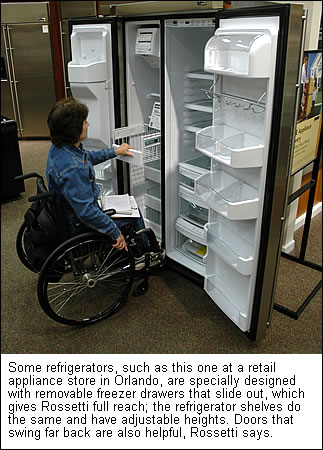
Suppose that accessibility issues were not addressed as afterthoughts in the production process of new products but were included within the design phase. And then suppose that these products proved advantageous not only to people with disabilities but to all people. This is universal design. "The intent of universal design is to simplify life for everyone by making products, communications, and the built environment more usable by as many people as possible at little or no extra cost. Universal design benefits people of all ages and abilities", according to The Center for Universal Design at North Carolina State University in Raleigh.1
Curb cuts are perhaps the most widely adopted and well known universal design feature. Designed to make sidewalks more accessible to people who use wheelchairs and those with other mobility impairments, curb cuts have benefited bikers, people pushing baby carriages, deliverymen, skateboarders, people pulling grocery carts, and everyone at one time or another. Universal design products range from kitchen tools, to appliances, to entire homes.
The Center for Universal Design has established seven Principles of Universal Design2:
PRINCIPLE ONE: Equitable Use
The design is useful and marketable to people with diverse abilities.
PRINCIPLE TWO: Flexibility in Use
The design accommodates a wide range of individual preferences and abilities.
PRINCIPLE THREE: Simple and Intuitive Use
Use of the design is easy to understand, regardless of the user's experience, knowledge, language skills, or current concentration level.
PRINCIPLE FOUR: Perceptible Information
The design communicates necessary information effectively to the user, regardless of ambient conditions or the user's sensory abilities.
PRINCIPLE FIVE: Tolerance for Error
The design minimizes hazards and the adverse consequences of accidental or unintended actions.
PRINCIPLE SIX: Low Physical Effort
The design can be used efficiently and comfortably and with a minimum of fatigue.
PRINCIPLE SEVEN: Size and Space for Approach and Use
Appropriate size and space is provided for approach, reach, manipulation, and use regardless of user's body size, posture, or mobility.
As universal design features are incorporated into more products and structures, the need for assistive technology should decrease. Why? Because the accessibility is built into the product or structure as part of the design; exceptional equipment is not needed by some people with disabilities.
(2) The Center for Universal Design (1997). The Principles of Universal Design, Version 2.0. Raleigh, NC: North Carolina State University.



No comments:
Post a Comment